
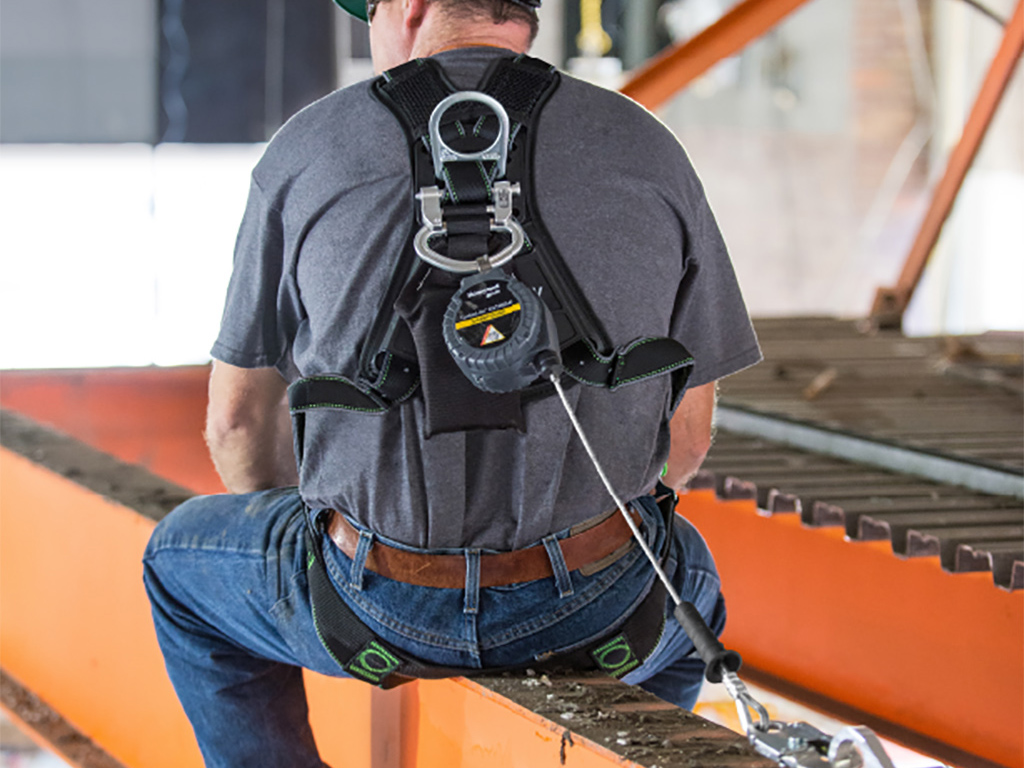
THE ABC’S OF OUR PERSONAL FALL ARREST SYSTEM
There are three key components of the Personal Fall Arrest System (PFAS) that must be in place and properly used to provide maximum worker protection. Individually, these components will not provide protection from a fall. However, when used properly and in conjunction with each other, they form a Personal Fall Arrest System that becomes vitally important to safety on the job site.
DO YOU KNOWYOUR ABC’S?
A – ANCHORAGE/ANCHORAGE CONNECTOR
Anchorage: Commonly referred to as a tie-off point
(Ex: I-beam, rebar, scaffolding, lifeline, etc.).
Anchorage Connector: Used to join the connecting device to the anchorage
(Ex: cross-arm strap, beam anchor, D-bolt, hook anchor, etc.)
- Anchorages must be capable of supporting 5,000 pounds (22kN) of force per worker
- Must be high enough for a worker to avoid contact with a lower level should a fall occur
- The anchorage connector should be positioned to avoid a “swing fall”
B – BODY WEAR
Body Wear: The personal protective equipment worn by the worker
(Ex: full-body harness).
- Only form of body wear acceptable for fall arrest is the full-body harness
- Should be selected based on work to be performed and the work environment
- Side and front D-rings are for positioning only
C – CONNECTING DEVICE
Connecting Device: The critical link which joins the body wear to the anchorage/anchorage connector
(Ex: shock-absorbing lanyard, fall limiter, self-retracting lifeline, rope grab, etc.).
- Potential fall distance must be calculated to determine type of connecting device to be used. Typically:
• Under 18.5 ft [5.6 m], use a self-retracting lifeline/fall limiter
• Over 18.5 ft [5.6 m], use a shock-absorbing lanyard or self-retracting lifeline/fall limiter - Should be selected based on work to be performed and the work environment
- Shock-absorbing lanyards can expand up to 3.5 ft [1.1 m] when arresting a fall
• Attach lanyards to the harness back D-ring only
• Never tie a knot in any web lanyard – it reduces the strength by 50%
Read full article:
The ABC’s of Fall Protection (.pdf)